
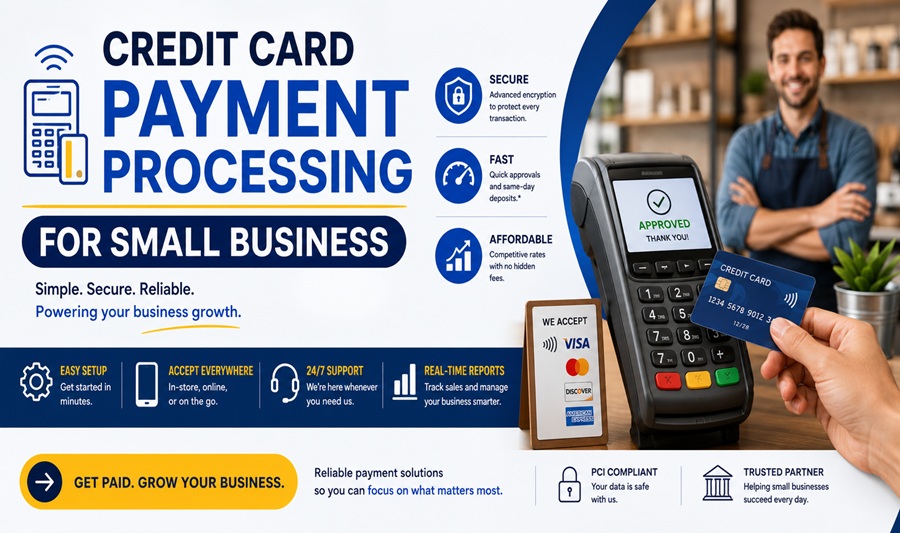
Every time a customer swipes, taps, or inserts a card at your business, a chain of events happens in milliseconds that ultimately results in money moving from their bank account to yours. That process is not free, and for many small businesses the fees it generates represent one of the largest recurring operating costs after rent and payroll. A business processing $20,000 in card sales per month at an effective rate of 2.5 percent is paying $500 per month, or $6,000 per year, in processing fees. At $50,000 per month, that figure rises to $15,000 annually. Understanding exactly how credit card payment processing works, what drives those costs, and how to structure your processing relationship to minimize unnecessary expenses is not a minor operational detail. It is a meaningful bottom-line lever.
How Credit Card Processing Actually Works
When a customer pays with a card, the transaction moves through several intermediaries before the funds settle in your business account. Understanding who those intermediaries are and why each charges a fee demystifies a cost structure that most small business owners accept without fully understanding.
The card issuing bank is the customer’s bank, the institution that issued the Visa or Mastercard in the customer’s wallet. It receives the interchange fee, which is the largest single component of processing costs and is set by the card network rather than your processor. Interchange rates vary by card type and transaction method, ranging from approximately 1.15 percent plus $0.05 for basic debit cards to 2.40 percent plus $0.10 for premium rewards credit cards on the Visa network.
The card network, Visa, Mastercard, Discover, or American Express, maintains the payment infrastructure that routes the transaction and sets the interchange rate. It charges assessment fees for use of its network, which are typically a small fraction of a percent per transaction and are nonnegotiable.
Your payment processor is the company you contract with directly to accept card payments. It routes the transaction through the network, handles security and fraud screening, provides the hardware and software interface, and deposits funds into your account. It charges a markup on top of the interchange and assessment fees to generate its own revenue. This markup is the only portion of your processing costs that is negotiable.
The Four Pricing Models and Which One Fits Your Business
The pricing structure your processor offers determines not just what you pay but how predictable and transparent your costs are. Understanding the differences between the four major pricing models helps you choose the arrangement that genuinely fits your business rather than the one that sounds simplest or looks cheapest on the surface.
Flat rate pricing combines interchange, assessment, and markup fees into a single fixed percentage plus a small per-transaction fee. Square charges 2.6 percent plus $0.10 for in-person transactions. Stripe charges 2.9 percent plus $0.30 for online transactions. PayPal’s rates follow a similar structure. Flat rate is genuinely simple and requires no analysis of monthly statements to understand what you paid. It works well for businesses with lower transaction volumes or those that prioritize predictability over optimization. The trade-off is that flat rate pricing almost always costs more than interchange-plus at meaningful transaction volumes because the processor’s margin is baked into the rate regardless of what the actual interchange cost was for each transaction.
Interchange-plus pricing passes the actual interchange cost through to the merchant and adds a fixed, disclosed markup on top. A processor might charge interchange plus 0.3 percent plus $0.10 per transaction. When the interchange rate is low because a customer paid with a basic debit card, you benefit directly. When it is higher because a customer paid with a premium rewards card, you see that too. This transparency is what makes interchange-plus the preferred model for higher-volume businesses that want to understand and optimize their actual costs. Helcim and Payment Depot use this structure.
Tiered pricing categorizes transactions into qualified, mid-qualified, and non-qualified buckets, each with a different rate. Processors define those categories themselves, which creates significant opacity about why a transaction landed in a particular tier and what the actual underlying cost was. Most payment professionals advise small businesses to avoid tiered pricing because it tends to be more expensive than both flat rate and interchange-plus and significantly less transparent.
Subscription pricing charges a fixed monthly fee plus a very low per-transaction rate on top of interchange, typically a few cents per transaction with no percentage markup. Stax starts at $99 per month and charges $0.08 per in-person transaction on top of interchange. For businesses processing $15,000 to $20,000 or more per month, the elimination of percentage markups can make subscription pricing the lowest-cost structure available. Below that volume threshold, the monthly subscription cost typically outweighs the transaction savings.
The Leading Processors for Small Business in 2026
As NerdWallet’s 2026 guide to credit card processing fees explains, the right processor depends on your transaction volume, your sales channels, and how much complexity you are willing to manage in exchange for lower rates.
Square is the most widely used processor among small businesses for good reason. Its hardware is accessible and well-designed, its software integrates point of sale, inventory management, and reporting into a single platform, and its flat rate pricing is genuinely simple. It has no monthly fee, no contracts, and next-business-day deposits for most accounts. Its rate of 2.6 percent plus $0.10 for in-person transactions and 2.9 percent plus $0.30 for online transactions is competitive for businesses processing up to $10,000 to $15,000 per month.
Stripe is the dominant choice for businesses operating primarily online, particularly those with developer resources who want to customize the payment experience. It supports over 135 currencies, extensive subscription billing capabilities, and the broadest range of payment methods of any mainstream processor. At 2.9 percent plus $0.30 for standard card transactions, the rate is identical to Square online, but Stripe’s API-first architecture makes it far more flexible for businesses with complex payment flows.
Helcim offers interchange-plus pricing with no monthly fees and automatic volume discounts as transaction volume grows. It is one of the most cost-effective options for businesses processing $5,000 or more per month and provides significantly more pricing transparency than flat-rate alternatives at comparable or lower effective rates.
PayPal Zettle is well-suited for businesses that want seamless integration between in-person and online sales through existing PayPal infrastructure. Its flat rate of 2.29 percent plus $0.09 for in-person transactions is among the lowest published flat-rate rates for 2026.
The Hidden Costs That Erode Small Business Profits
The advertised processing rate is not the only cost associated with accepting credit cards, and small business owners who evaluate processors based on transaction rates alone routinely encounter additional charges that were not prominently disclosed.
Monthly fees exist on many processor accounts, ranging from $10 to $50 per month, and are charged regardless of transaction volume. PCI compliance fees, which cover the cost of the processor certifying that your payment environment meets Payment Card Industry security standards, can run $10 to $30 per month or appear as annual charges of $100 to $300. Some processors include these in their pricing. Many charge them separately.
Chargeback fees are levied every time a customer disputes a transaction and the funds are reversed. Standard chargeback fees run $15 to $25 per incident, and for businesses in higher-risk categories or those with elevated dispute rates, these can become a meaningful cost. Preventing chargebacks through clear refund policies, detailed receipts, recognizable billing descriptors, and prompt customer service is both financially and operationally important.
Early termination fees apply to processors that require long-term contracts, typically running one to three years. Breaking a contract early can trigger fees of $200 to $500 or more. Square, Stripe, and most modern processors operate month to month without termination penalties, which is one reason they have captured so much of the small business market.
Batch fees, statement fees, and address verification fees are additional per-transaction or periodic charges that appear on some processor statements. Reviewing a complete fee schedule before committing to any processor is essential, not just the headline transaction rate.
Reducing Your Processing Costs: Practical Strategies
For businesses already accepting cards, several strategies can meaningfully reduce effective processing costs without requiring a processor change.
Encouraging customers to pay with debit cards rather than rewards credit cards reduces interchange costs because debit transactions carry lower interchange rates. While you cannot control how customers choose to pay, accepting and displaying that debit is welcome encourages the lower-cost option without creating friction.
Implementing cash discounting or surcharging shifts processing costs to the customers who incur them. Cash discounting offers a reduced price for cash payment and displays the card price as the standard retail price. Surcharging adds a fee to credit card transactions. Both approaches are legally permissible in most states following rules established by card networks, but they require proper implementation and disclosure to remain compliant. Surcharging is prohibited on debit card transactions.
Negotiating with your current processor is a realistic option for businesses processing $10,000 or more per month. Interchange-plus processors in particular have flexibility on the markup component of their pricing, and a documented quote from a competing processor is the most effective negotiating tool. Processors would rather reduce margin slightly than lose an account.
Re-evaluating your pricing model as your volume grows is something most small business owners fail to do. A business that started with Square at $3,000 per month in volume and has grown to $40,000 per month is almost certainly overpaying relative to what an interchange-plus or subscription model would cost at the same volume.
Security, Compliance, and Protecting Your Business
PCI DSS compliance, the set of security standards established by the Payment Card Industry Security Standards Council, is not optional for any business that accepts card payments. Compliance requirements vary based on how you accept payments and your transaction volume, but the foundational requirements apply universally: encrypt cardholder data in transit and at rest, maintain secure network configurations, restrict access to cardholder data, and regularly monitor and test security systems.
EMV chip card processing reduces fraud liability for in-person transactions. Since 2015, businesses that do not support EMV chip processing have assumed liability for counterfeit card fraud that would otherwise fall on the card issuing bank. Ensuring your payment hardware supports chip transactions is both a security requirement and a financial protection.
Tokenization, which replaces actual card data with a unique identifier that is meaningless if intercepted, is a security feature embedded in all reputable modern processors. Understanding whether your processor uses tokenization for stored card data matters most for businesses that save customer payment information for recurring billing or subscription purposes.
Credit card payment processing is an unavoidable cost of doing business in a cashless economy, but it is not an unmanageable one. Choosing the right pricing model, selecting a processor that fits your volume and sales channel, and staying attentive to the full cost picture rather than just the headline rate makes a measurable difference to the profitability of every business that takes it seriously.
This article is for informational purposes only and does not constitute financial or legal advice. Please consult qualified professionals for guidance specific to your payment processing situation.
